





Exercise Equity: Access & Impact to CA Residents
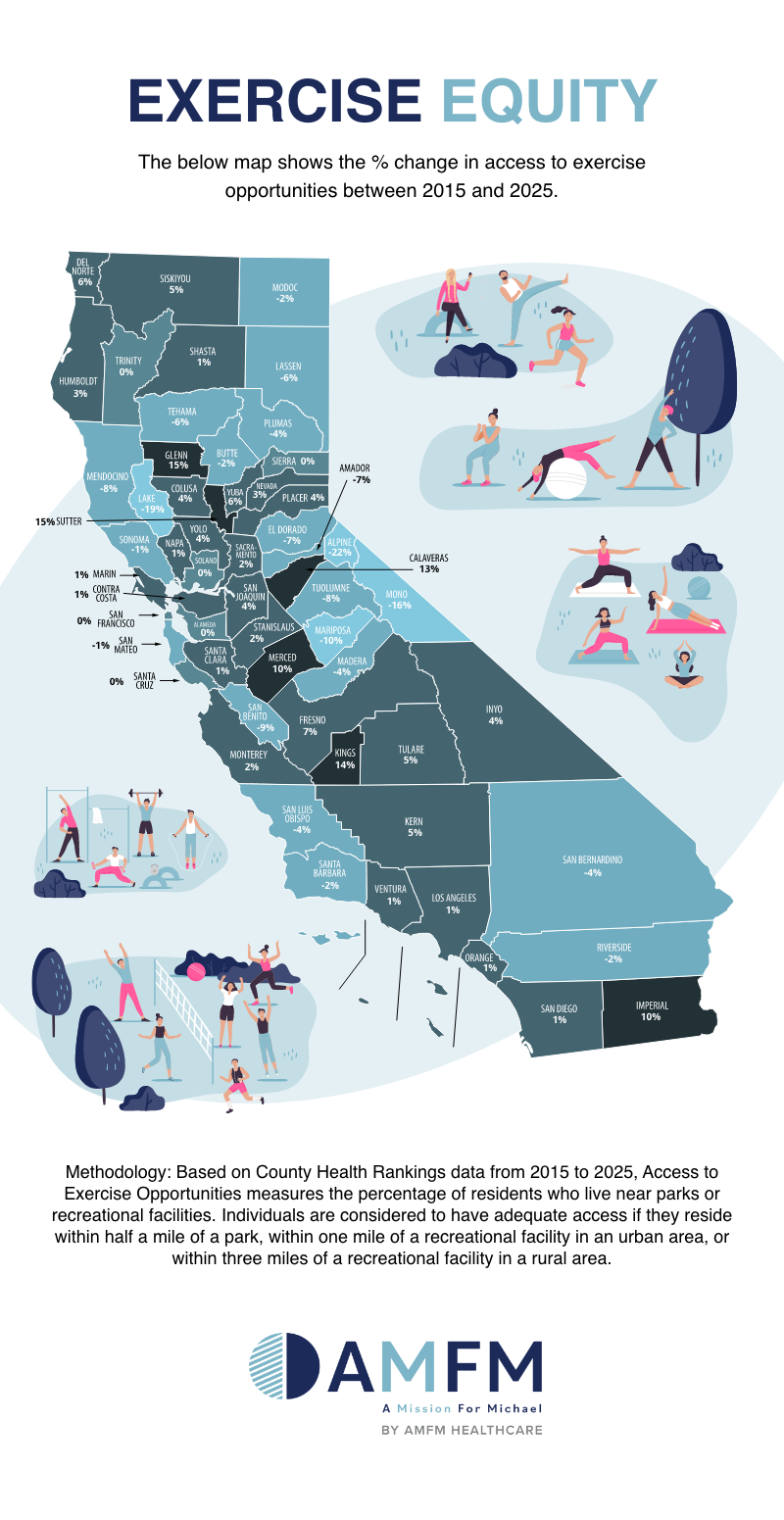
Exercise Equity
Exercise isn’t just good for your body — it’s one of the best things you can do for your mind, too. In California, where sunshine and outdoor living come naturally, staying active is almost a way of life. Physical activity releases endorphins and serotonin — nature’s built-in stress relievers — while helping you sleep better, think clearer, and generally feel more balanced. Whether it’s a beach jog in Santa Monica, a hike through the Marin Headlands, or a quick ride down the Pacific Coast Highway, movement is how many Californians reset their mental health.
To see how that opportunity has changed over time, A Mission for Michael dug into ten years of county-level data (2015–2025) and ran a new survey of 2,000 Californians. The goal: to find out which areas have made it easier for people to get moving — and which ones have fallen behind.
Here is what they found. The top 10 counties for most improved access to exercise opportunities:
- Glenn: 15% improvement
- Sutter: 15%
- Kings: 14%
- Calaveras: 13%
- Imperial: 10%
- Merced: 10%
- Fresno: 7%
- Del Norte: 6%
- Yuba: 6%
- Kern: 5%
On the flipside, those with the greatest declines were:
- Alpine: -22% decline
- Lake: -19%
- Mono: -16%
- Mariposa: -10%
- San Benito: -9%
- Mendocino: -8%
- Tuolumne: -8%
- Amador: -7%
- El Dorado: -7%
- Lassen: -6%
- Tehama: -6%
What the Numbers Tell Us
- Big wins for small towns: It’s striking that many of the most improved counties — Glenn, Sutter, Kings, and Merced — are small and agricultural. Over the past decade, community parks, walking trails, and recreation programs have expanded in places that once had very few options.
- Nature doesn’t always mean access: Some of California’s most scenic areas, like Alpine and Mono counties, actually saw sharp declines. Beautiful surroundings don’t automatically translate into accessible fitness infrastructure — especially in regions where population and budgets are limited.
- Urban stability hides rural gaps: Major metro areas didn’t top either list, but that’s part of the story. Cities like Los Angeles and San Diego tend to maintain steady access, while the gap between thriving and struggling counties keeps widening.
- Exercise equals mental reset: The survey found that residents in improving counties were also more likely to report better stress management and stronger community ties — proof that exercise access isn’t just about fitness, but feeling grounded.
What Californians Say About Exercise Access
A Mission for Michael’s statewide survey of 2,000 Californians uncovered a clear message: people want to move more — but money, safety, and accessibility often stand in the way.
When asked what would most improve their access to exercise opportunities, residents didn’t hesitate:
- 37% said lower gym membership costs would make the biggest difference.
- 27% pointed to feeling safer in outdoor spaces.
- 25% wanted more public parks or trails.
- 11% said better public transport or parking would help.
That mix tells an important story — Californians love being active, but affordability and safety are just as crucial as sunshine and scenery.
Mental Health Connection
The mental health link couldn’t be clearer.
A huge 84% said they notice a positive difference in their mental health when exercising regularly.
Only 16% said they don’t notice a change.
That reinforces decades of research showing that movement is one of the simplest ways to reduce stress and boost mood — something Californians clearly feel firsthand.
The Cost Barrier
Finances came through as a major theme.
- 86% said they would exercise more if local facilities were free or subsidized.
- 58% agreed that staying fit in their county has become a privilege for the wealthy.
- Nearly half (46%) went as far as to say exercise has become a luxury.
When it comes to gym costs, frustration runs deep:
- 36% described current prices as “borderline extortionate.”
- 52% said they’re somewhat too high.
- Only 11% felt the fees were fair enough.
Safety and Accessibility
Feeling unsafe also keeps many residents on the sidelines.
- 48% admitted to skipping exercise at some point because they felt unsafe outdoors.
It’s a reminder that access isn’t just about infrastructure — it’s about creating environments where people feel comfortable walking, running, or cycling without fear.
A Call for Support
Encouragingly, most respondents backed community-based solutions: 84% said they would support local government programs offering free gym passes to low-income residents. That finding shows Californians aren’t just aware of the inequality in access — they’re willing to do something about it.
“Our findings highlight a growing equity gap in something as fundamental as physical activity,” says Anand Mehta, LMFT of A Mission for Michael. “Eighty-six percent of Californians say they would exercise more if facilities were affordable or subsidized. The connection between access and mental health is undeniable — it’s time we treat it as a public health priority.”
